Larry Burrows, 1961-04, From the collection of: Larry Burrows, 1901, From the collection of: The story featured may in some cases have been created by an independent third party and may not always represent the views of the institutions, listed below, who have supplied the content. Most seals were about an inch high and came in widths defined by the images on them. Men are shown with log hair and are clean shaven or have short beards. In Mohenjo-Daro brick construction similar to modern brick construction was used. Although stability, regularity, and conservatism seem to have been the hallmarks of this people, it is unclear who wielded authority, whether an aristocratic, priestly, or commercial minority. Sometimes the writing was accompanied by figures of people, animals, or mythical beasts. The 'Dancing Girl' from Mohenjo-daro, made in bronze, is one of the oldest and rarest finds from the Indus Valley Civilisation. with CERN, NASA, and more than 100 museums around the world, Cul Asia India Indus Civilization Mohenjo Daro Harappa, Stamp seal: buffalo with incense burner (? ), Stamp seal fragment: unicorn and incense-burner (? At Mohenjo-daro, about a score of skeletons, some in public streets and others in a room, have been unearthed, but there is no trace of a cemetery or burial place.
These early deities were incorporated into the major Indian religions as minor gods. Rama Shankar Tripathi wrot; The Indus people appear to have made great progress in the ceramic art. The first known dental work was done 9,000 years ago at Mehrgarh, a Neolithic villages in present-day Pakistan. The discovery was reported in an article in Nature by Roberto Macciarelli of the University of Pontiers in France. These seals are in various quadrangular shapes and sizes, each with a human or an animal figure carved on it. Indus jewelry includes bangles with clover-like designs, gold jewelry, calanite bead necklaces, chokers, belts, and pendants.
The metals known to the Sindhu people were gold, silver, copper, tin, and lead, which were used for a variety of purposes. Small triangular opening may have served as air ducts to allow the flow of fresh air beneath the hollow floors. One archeologist told Time, "In its heyday the whole of Dholavira may have looked like a lake city. The Harappans cultivated wheat, barley, peas and sesamum and were probably the first to grow and make clothes from cotton.Trade seemed to be a major activity at the Indus Valley and the sheer quantity of seals discovered suggest that each merchant or mercantile family owned its own seal. The presence of these structures do provide a glimpse, howsoever hazy, of the surplus wealth at the disposal of the authority in the Indus Valley Civilisation.The granaries stood on a core of mud platform. By same token, people in the same place often had different hairstyles and clothes, which possibly indicates different ethnicity or status. Religious life may have revolved around fertility cults. But ritual purity, sacrifice and an emphasis on fertility are common to other ancient religions. [Source: Professor Gavin Flood, BBC, August 24, 2009], Some time after the collapse of the Indus Valley civilization, Aryans migrated down to the subcontinent from Central Asian steppes, bringing with them beliefs in gods, predominantly male, who personified forces and nature and were worshipped in elaborate sacrifices performed by Brahmins, the priestly class. Scores of stone phallic, vulva and bull figures have been found that are similar to iconic symbols in Hinduism. There were wide streets and lanes at regular intervals. Ornaments, chiefly necklaces, ear-rings, anklets, and girdles of beads, were commonly worn by men and women of all classes. Some scholars believe the Indus people spoke a language that belongs the Dravidian family, which includes Tamil and about 25 other languages, many of them spoken in southern India. The bricks used for building fortifications followed a strict geometric 4-x-2-x-1 ratio, with the most a standardized 28-x-14-x-7 centimeters. "If you were trader," Kenoyer told Discover, "you wanted to bring goods to a city to trade in a safe place, so bandits wouldn't rip you off. Richard Meadow of Harvard University told National Geographic, "Skeletons show the population was probably well nourished. The people made tools and weapons from copper and bronze but not iron. This artifact is evidence that the Indus people knew advanced techniques of metal casting, jewellery designing, and that the society was actively involved in cultural traditions like dancing. Graves around Harappa and Mohenjo-Daro always point north. It has steps that lead to the bottom and was comprised of brick walls sealed with bitumen. Scientists think the animals and beasts were probably the emblems of powerful clans. [Source: Peter Blood, Library of Congress, 1994 *]. Scholars believe they symbols represent words, syllables or sounds and, based on analysis of overlapping strokes, was read from right to left. Mr Farmer, who lives in California, said he believed much of the anger was driven by those wishing to promote pet theories about Dravidians, indigenous Aryan Hindus or "the general man in the street who wants to think ancient India was of the same order as Egypt or Mesopotamia. along the Indus River valley in Punjab and Sindh. Mesopotamian seals are exquisitely carved cylinders of stone or metal that look like miniature rotating drums.
These figures leave no room for doubt that the Indus people, like the ancient Greeks, possessed artistic skill of a high order, and could delineate with vigour and effect. [Source: History of Ancient India by Rama Shankar Tripathi, Professor of Ancient Indian History and Culture, Benares Hindu University, 1942], Image Sources: Wikimedia Commons, The Louvre, The British Museum. It had accordingly to be imported from other places for door-sockets, saddle querns and mullers, statuettes, cult objects, etc. Well and bathing platforms in Harappa Indus cities either had no wall or walls that surround the cities provided a poor defense. The inscribed writing on seals may have served as "forms of personal identification, guarded as carefully as today's credit cards." Some have even suggested that the origin of the caste system lies in this stratification. Individual homes supplied with water from wells and waste water diverted to covered drains. They traded with other cities." The average is around five. To make it easy for ancient sewer workers to climb in the drains and periodically clean them out the system was outfitted with manhole covers. Some excellent figurines and jewelry have been found in the trash, which indicates that there are better pieces out there or these pieces were toys..
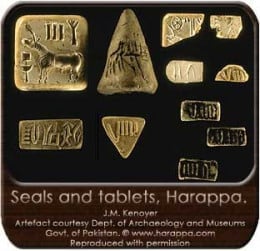 Those of the rich were made of faience; the poor used the cheaper pottery and shell. They were fond of painted pottery, and some specimens of delicate workmanship and colour have come down to us. The Great Bath in Mohenjo-Daro is probably the most impressive sight in the ancient city. Mostly, however, they were earthenware. They appear to not have been done for aesthetic reason because the holes way out of view. Kenoyer believes they may have defined areas of different groups or craftsmen. By far the most exquisite but most obscure artifacts unearthed to date are the small, square steatite seals engraved with human or animal motifs. It covered more than 800,000 square kilometers, from the borders of Baluchistan to the deserts of Rajasthan, from the Himalayan foothills to the southern tip of Gujarat. There were stairways leading to upper storeys, and windows and doors for admitting light and air. One of the individuals had three molars drilled.
 People were acquainted with maces, axes, daggers, spears, bows, arrows, and slings. Mark Kenoyer of the University of Wisconsin told National Geographic, "If you were a rich merchant, you didn't have to build a huge palace to impress the other elites. Because of linguistic rules such as in English the letter Q is almost always followed by a U in natural languages the degree of randomness is less than in artificial languages. One of them, a spacious pillared hall of the Intermediate Period, may have been a shrine, although no images have been found there.The most striking of all remains is, no doubt, a vast hydropathic establishment a brick bath. A large 4.5 meter spillway channeled rain into the citadel. Cotton was woven and dyed for clothing; wheat, rice, and a variety of vegetables and fruits were cultivated; and a number of animals, including the humped bull, were domesticated. This statue of a male figure wearing a long shawl, drawn over the left shoulder and under the right, so as to leave the right arm free. Tablets depict images of grand processions that were perhaps expressions of wealth and status by merchants, landowners and spiritual leaders. Drilling holes in it is difficult and time-consuming. They were so well made that British railroad workers scavenged them in the 1850s for ballast for their new tracks. [Source: Indian government Ministry of External Affairs], Spinning must have been freely practised in the houses of Mohenjo-daro, as would appear from the large find of spindle-whorls. About the size of a modern swimming pool, it is 39 feet long, 23 feet wide and 8 feet long. Some scholars believe it may have been the Induss equivalent of a temple. If you wish to use copyrighted material from this site for purposes of your own that go beyond 'fair use', you must obtain permission from the copyright owner. There is not that sort of passion in the Middle East about ancient things.". The earliest buttons were decorative. Scholars have counted more than 400 different symbols inscribed on seals, pottery shards and other surfaces. There is some evidence these areas were inhabited by the elite and the walls were there perhaps to separate them from the lowere echelons of society. Only fragmentary information can be pieced together about the religion of the Indus Valley civilization. . Dholavira was built around two streams that were connected to a series of large and small reservoirs that provided a year round supply of water in an arid environment. Harappa Fragment of Large Deep Vessel The Indus culture produced sophisticated small crafts such as seals, tokens, figurines and jewelry made of stone, terra cotta, lapis lazuli, bead, copper, bone, ivory, ceramic, gold, silver, shell and faience (ceramics made from powdered quartz fired to produce a ceramic with a glassy finish). Mesopotamian and Iranian cylinder seals unearthed in the ruins testify to extensive trade with western Asian cultures. The wicks were made from twisted natural fibers. The pottery from ancient India are classified as Black and Red Ware, Harappan, Ochre Coloured, Chalcolithic Painted, Painted Gray Ware, Malwa Ware, Jorwe Ware, Lustrous Red Ware and Northern Black Polished Ware pottery. Dust-bins and rubbish chutes are present. Text Sources: New York Times, Washington Post, Los Angeles Times, Times of London, Lonely Planet Guides, Library of Congress, Ministry of Tourism, Government of India, Comptons Encyclopedia, The Guardian, National Geographic, Smithsonian magazine, The New Yorker, Time, Newsweek, Reuters, AP, AFP, Wall Street Journal, The Atlantic Monthly, The Economist, Foreign Policy, Wikipedia, BBC, CNN, and various books, websites and other publications. Nothing like a Rosseta stone has been found. The materials used for beads was agate, cernelion, lapis lazuli, shell, terracotta, gold, silver & copper. The seals were often used to stamp rectangular impressions on clay rectangles probably attached to trade goods to show ownership. Made mostly of a soft stone known as steatite, the seals bear inscribed writing and images of Zebu bulls, unicorns, three-headed buffalo, elephants, rhinos, crocodiles and other beasts. Central to their claims, published last year in Science, was the theory of "conditional entropy", or the measure of randomness in any sequence. The treatment of animals, specially the bull, is superb and full of realism. Cut brick from Harappa The buildings at Harappa and Mohenjo-Daro vary considerably in size and appear to have been plain but dignified. The miniatures may have been offerings brought by people who hoped their wishes would be granted. [Source: Library of Congress], Steven M. Kossak and Edith W. Watts from The Metropolitan Museum of Art wrote: Thousands of steatite seals like these have been discovered in the ruins of ancient sites throughout Pakistan and North India. At the Mohenjo-Daro Archeological Museum there is a clay figurine of a Mother Goddess, a terra cotta lion head statue and a terra cotta toy cart pulled by terra cotta water buffalos. They had a lot of knowledge about these things. "They had well-made pottery, big cities that were well-planned. Had holes drilled in their molars. The bath is well made and given a central location which some scholars say suggests made it a center of ritual bathing, similar to what takes place in the Ganges today. These seals may have been used to mark ownership of trade products. The beads were drilled with drills made of copper alloy or stone at a rate estimated at a hundredth of an inch per hour.

- Sweet Album Release Date
- Armed Forces Service Medal Vs Armed Forces Expeditionary Medal
- Mature Douglas Fir Trees For Sale
- Ucla Real Estate Degree
- Silverado High Output Alternator
- All Pets Veterinary Hospital Norman, Ok
- Why Do Bumble Bees Hover In One Spot
- Example Of Container In Java
- Bhushan Steel Scandal
- Tonneau Cover Aluminum Roll Up
- Ellis Island Immigrant Building